Quiltwright
Holographic output for scientific visualization.
Eric G. Suchanek, PhD -- Flux-Frontiers
Quiltwright is the last stage of a scientific rendering pipeline -- any
pipeline that ends in a scene. It takes what you already have -- a PyVista or
VTK scene built in memory, a ParaView session saved as a .pvsm, a Blender
file or an exported mesh, or a .pov file written thirty years ago by someone
who is no longer around to explain it -- and puts it on holographic hardware in
glasses-free depth. Nothing is rewritten to get there: your scene file is never
modified, the off-axis camera is supplied per view, and each scene is rendered
by the renderer it already belongs to. Where that renderer is Blender's Cycles,
the views are path-traced on the GPU's ray-tracing cores if the hardware has
them; where it is ParaView, the sweep runs inside ParaView's own pvpython, so
the pipeline, color maps and transfer functions you built come across intact.
It is used that way by WaveRider for geometric ML manifolds and by pypdb2pov for molecular structures, but neither is a prerequisite. If you can render it, you can hang it in the air.
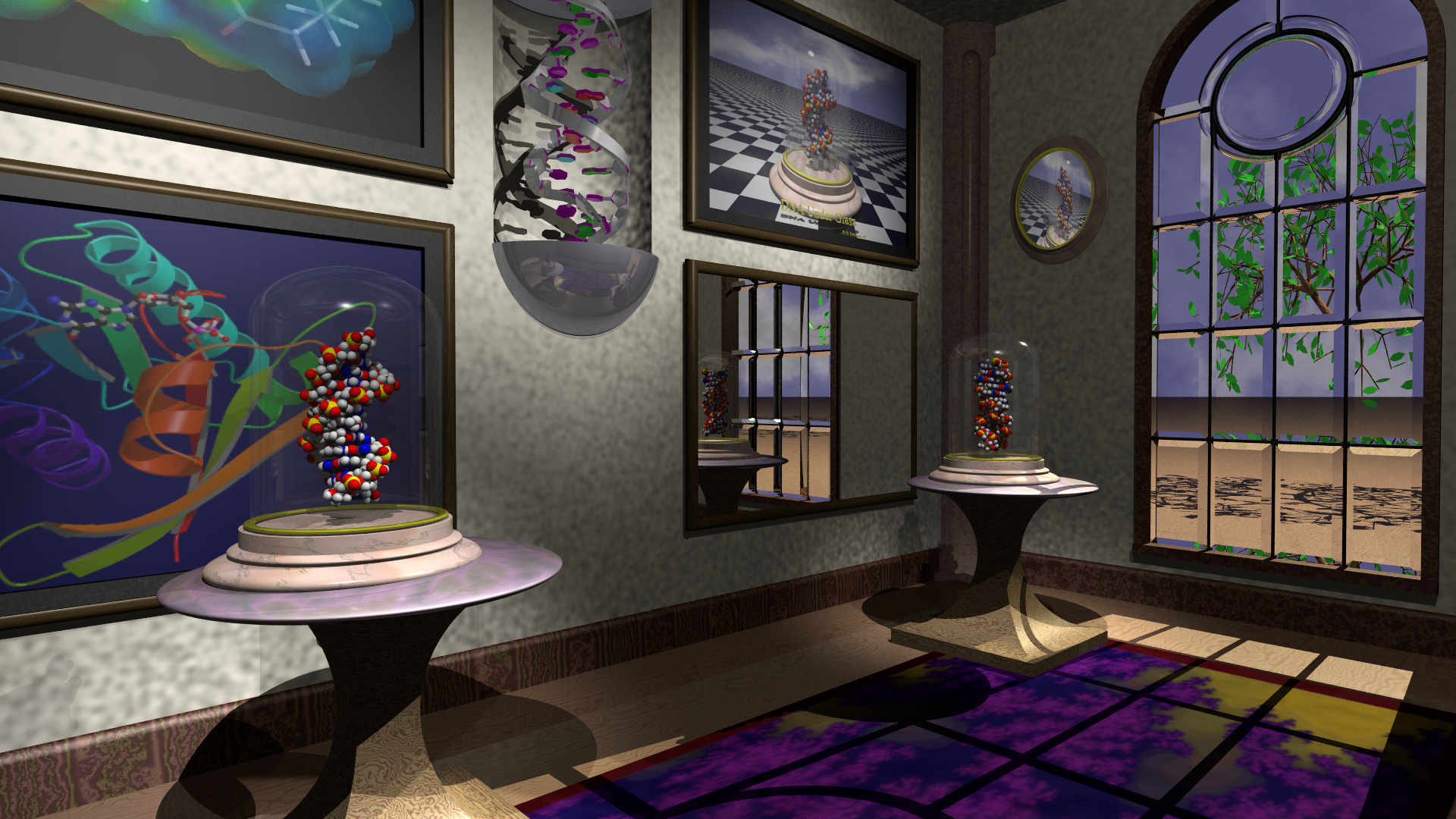
A career in structural biophysics, arranged as exhibits: B-DNA and Z-DNA under bell jars, Ras and my original DNA Under Glass on the walls. The molecular models were generated by pdb2pov in 1997; the room dates to 1995. Quiltwright ray-traces it into a 48-view light-field quilt for Looking Glass light-field panels, or into 2-D video for Hololuminescent displays. About the image
Where to start
| Installation | Package extras, POV-Ray, ffmpeg, Bridge, pypdb2pov |
| Usage recipes | PyVista, POV-Ray, Cycles, ParaView, casting to Bridge, printer sweeps, depth budget |
| The shell workflow | Every make target, the parallelism model, run reports, and what each CLI command is for |
| CLI reference | Every quiltwright command and flag |
Backends
| PyVista / VTK | Light-field output, Bridge/Studio setup, device presets, view sweeps for hologram printers |
| POV-Ray | Off-axis camera derivation, depth budget, sweep clearance, a worked case study |
| Blender Cycles | Hardware ray tracing (Metal/OptiX/HIP), mesh and .blend scenes, one process per sweep |
| ParaView | A saved .pvsm session swept in place by pvpython, pipeline and color maps intact |
| Mesh import | Any 3D object file (glTF/GLB, OBJ, FBX, USD, ...) to a quilt in one command |
| Writing scenes with povgen | Analytic primitives, so a scene composed in Python can be ray-traced rather than rasterized |
| The archive-scene workflow | Taking an archive scene from "won't parse" to a quilt that fuses, step by step |
| Molecular scenes | Rendering molecular structures as holograms with pypdb2pov |
| Hololuminescent Displays | Ordinary 2-D video rather than quilts |
Scene sources
| PyVista example datasets | Topography, the Allen mouse brain atlas, other strong-depth candidates |
| The Virtual Brain | Cortical surfaces, connectomes, parcellations, downloaded on demand |
See also the gallery of every rendered scene, and the architecture behind the package layout.
The API reference is generated from the package's own docstrings.
Source
Quiltwright is BSD-3-Clause and lives at github.com/Flux-Frontiers/quiltwright.