About the image
Scene: pov-scenes/museum/museum.pov --
"Eric's Science Museum"
Begun: 10 June 1995 -- Last revised: 14 March 1997 -- Rendered as a
hologram: 2026
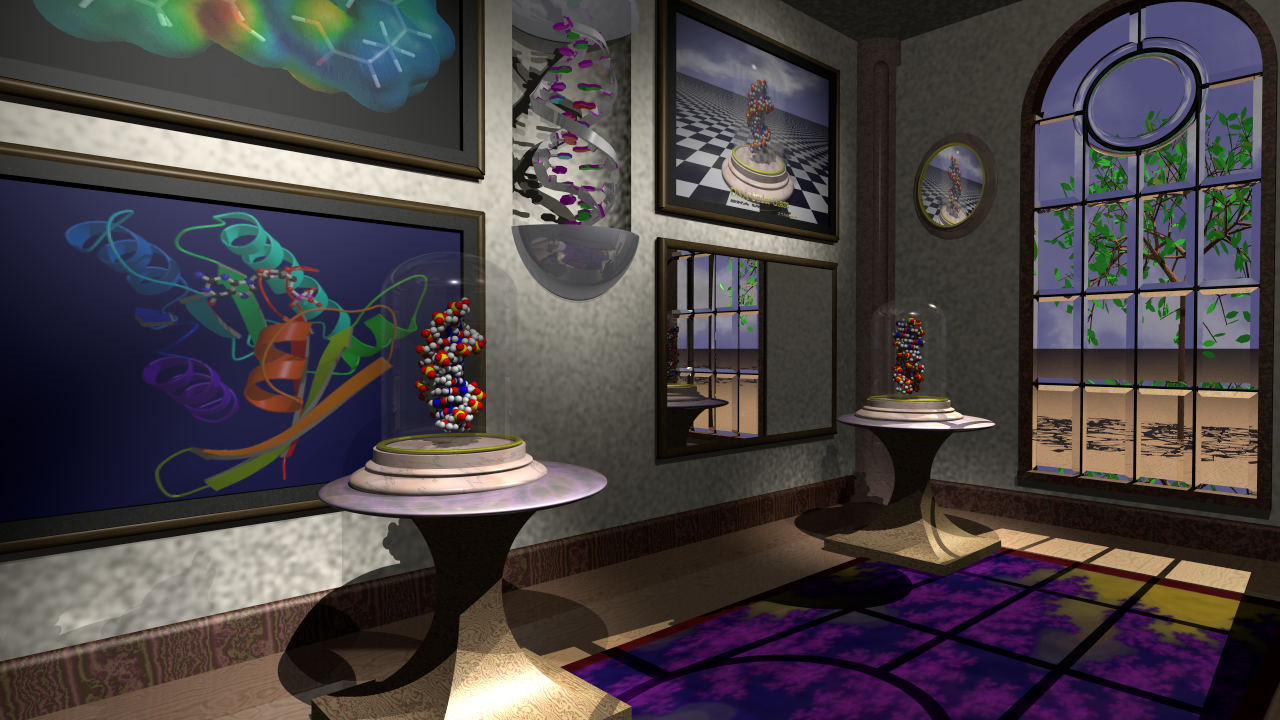
Center view of the 48-view quilt, 1280×720 -- the view as captured, before
assemble_quilt squeezes it anamorphically into the quilt's 960×720 tile.
A raw tile is not a viewable still: 16:9 content in a 4:3 frame renders
everything a third too tall.
What it is
A museum room with the exhibits removed and replaced.
The architecture is borrowed and credited: the walls, the columns, the arched
window, the picture frames and the display pedestals are Michael "meek"
Mittelstadt's, from early 1994. His files still carry his name where they sit
in this repository -- world2.inc, column.inc (23 Feb 94), window.pov
(15 Mar 94), picframe.pov and display_base.pov (Mar 94) -- and an early
variant of the scene is headed, plainly, "Eric's Museum (based on Meeks
museum)". It was a good room, and it was used as a room.
Everything the room contains is the author's own scientific work. That is the point of the image: a career in structural biophysics, arranged as exhibits and lit like a gallery. Not an illustration of the work -- an integration of it, gathered into one frame.
What is on display
| Where | Exhibit | Source |
|---|---|---|
| Left pedestal, under glass | B-DNA, space-filling, 758 atoms | bna7_full.inc -- generated by pdb2pov, 14 Mar 1997 |
| Right pedestal, under glass | Z-DNA, the left-handed helix | zdna_bj.inc |
| Alcove, center | DNA cartoon mobile, suspended between two silver bowls | dna_cartoon.inc |
| Lower left wall | Ras, ribbon diagram with the nucleotide bound in its site | ras.tga |
| Upper left wall | A small molecule under a color-mapped electrostatic surface | prostapic.tga |
| Upper right wall | "DNA Under Glass" -- the bell-jar still life on the checkerboard ground | bell_jar.tga |
| Back wall | A mirror, doubling the room | picframe.pov |
| Right | Mittelstadt's arched window, onto terrain, a tree and sky | window.pov |
Two more finished pieces sit in the include tree without being hung in this
particular view: A-DNA (adna2.inc, 502 atoms, pdb2pov, 11 Mar 1997) and
Lambda Repressor '98 (lambdapic.tga), the repressor clamped onto its
operator DNA over open water.
The through-line
The B-DNA in the left bell jar is not a model of the pdb2pov pipeline's output. It is pdb2pov's output, and the file says so in its own header:
// PDB2POV (DOS) atom input prepared by pdb2pov 03/14/97 19:50:19
//  Atoms:  758
//  Enclosing Sphere: 26.271
pdb2pov was written in 1993, in C, for DOS. It still builds from a fresh clone. The scene it fed in 1997 is the scene Quiltwright ray-traces into a light-field quilt today, unmodified -- the renderer appends a camera and touches nothing else. Between the atom coordinates and the glass sits a pipeline roughly thirty years long, and every stage of it still runs.
Why it holograms well
This was composed as a still, and it happens to be close to ideal light-field content -- for reasons that are worth naming, because they generalize:
- A foreground anchor. The near pedestal and bell jar sit 31 units out, well in front of the 46.9-unit focal plane, so they float clear of the glass.
- Structured mid-depth. Framed art on three walls at staggered distances gives the eye something to parallax against. Depth reads as depth only when there is a relationship between layers. One painting lands within a unit of the focal plane, welded to the glass while the room moves around it.
- A window to infinity. About 6% of the frame is sky seen through the arch -- at effective infinity, and low-contrast, which is exactly where a light-field display can afford its largest disparity.
- Glass and refraction. Two bell jars and a mirror. Ray-tracing pays for itself here; these are the elements a rasterizer approximates and a holographic display then magnifies.
It also has the failure mode peculiar to interiors -- the view sweep runs into a wall -- which is documented, with the measurements, in povray.md section 3 and section 4.
Exhibit subjects were identified from the scene's own filenames and imagery; corrections from the author supersede them.